Search This Blog

May 14, 2011

Tracking The Gorillas of Bwindi


About half way over the mountain
Today the ultimate journey of a lifetime begins early in the morning.  We have breakfast and pack a day bag with water and protein bars. Our banda is only about a 5 minute walk to where we meet our guides.  There are already a slew of excited trekkers waiting for directions outside of the main office of the park.  Once everyone has arrived the guides give us a briefing of what to expect on our journey, he explains there are 5 groups of gorillas in the surrounding forests and informs us that the previous day (and all week) the trakers have had success in locating all 5 groups.  Basically the way that this gorilla tracking works is the trackers set out about 1 hour before the rest of us, equiped with only 2 way radios and guns, they attempt to retrace their steps from the day before.  They head in the direction that they lost saw the gorillas and attempt to locate where they nested the night before and then determine a direction to set off in.  Once they are located, the trackers radio back and forth to our guides until we reunite with them.  But first we must sit down and watch a video about the gorillas and their protected habitat. 

Our first view of the Gorillas!!
curiosily inspecting the latest visitors
During this briefing we are told about the different groups of gorillas.  There seems to be advantages and disadvantages to seeing all of the different groups.  Nobody has a choice as to which group we will be seeing, but we feel we are very lucky because our group of trackers will be going to see the group of gorillas which has just given birth to a baby gorilla!  We are told that this group is very small in number but the fact that we get to see a 2 or 3 day old gorilla more then makes up for it.  We are also told that within the last couple of days one of the groups has lost a younger male silver back during a turf war with another group.  This is a natural process and thankfully doesn't happen all too often.   We are told that there are approximately 340 gorillas (about half of the entire planet's population) in total in this vast tract of land that spreads deep into the Congo and dips slightly into the Rwandan border. Back in 1997 when the protected area was formed there were about 300 gorillas, so they've seen a modest increase in the species since these efforts to protect them were established.

Bwindi Gorilla eating flower
The briefing finishes with the ground rules of the park.  If we have any sort of illness, we are not to participate in the tracking because the gorillas genetics are so similar to ours that we could pass on our illness/disease.  Lucky for us we're nice and healthy. The other rule is that we are to stay at least 20ft away from them at all times.  We also find out that the group we're going to see has a gorilla in it which is very comfortable with humans and often comes in close proximity to us...if he touches us we are to resist the urge to touch him back.  We are advised that this trek is not a simple task and if anyone wants to hire porters to carry their bags/equipment (there are some seriously professional photographers in our group) or to even carry THEM they can arrange for it.

I'm losing patience with you taking my bed away!! Don't mess with me!
Finally on our way!! After about 30 minutes of walking our guides receive a call from the trackers that they've located our group...they are about 2 hours ahead of us.  We just take our time and enjoy the rain forest and surrounding lush mountains.  For most of this time we are following very well used trails but as soon as we made our way to the bottom of the large hill we just climbed over, our trail becomes more and more dense and less and less clear.  Lucky for us we have two guides out front literally hacking back the brush with giant machettes! 


We ended up walking through some pretty swampy areas where there were obviously tons and tons of bugs, but for some reason the bugs are not bitting us at all.  They are more of a nuisance then a danger.  As we get closer and closer to the gorillas the forest is getting more and more dense, we are now asked to stay as quiet as possible because we don't want to startle them.  Our guides out front start making this very throaty rumbling sound with their mouths, we are told that this is how gorillas who are friendly to the group greet each other.  The gorillas can obviously hear and sense us coming so by doing the friendly greeting we are letting them know we mean them no harm.  Anticipation and excitement is building, at this point Marlene and I are near the back of the group and we are visually told to walk slowly...we can now see the people in the front pointing, smiling and taking photos...as we approach...

Absolutely STUNNING!! This is the greeter gorilla, apparently he is always the first of the gorillas in this group to be spotted and the trackers now know the rest of the group can not be very far from us. The greeter gorilla is just sitting on top of some vines happily eating leaves and flowers.  We are told that the greeter gorilla is very comfortable with humans because he is quite young and he was born after the tourists started coming, meaning he has seen humans almost every single day for his whole life.  He knows they mean no harm to him. The guides tell us that he actually enjoys the company of humans.  The rest of the group is not so happy to see us.  Not that they are afraid or aggressive towards humans but they would rather we just left them alone.

silver back hanging out in Bwindi
As we continue on we catch a glimpse of the large male silverback.  He's very hard to spot in the thick brush but I can just barely see him through my lens as he lays on the ground, on his belly, staring at his finger nails. For the greeter gorilla the guides seem to ignore the 20 ft rule, but for the silver back, nobody want to get any closer then that, nobody wants to challenge his space.  The guides push on past the silver back in search of the momma and new baby gorilla.

We push on through the brush until we finally come across the rest of the group.  We see the momma who is carefully hidding her new born, the adolescent gorilla is sitting nearby guarding the newest member of the group.  When we come across them the mother is very hidden and the adolescent has his back to us.  As we move closer he moves closer to the mother and begins to groom her.  The guides want to give us a better view so they begin pulling and slashing the branches and vines away.  Now we can see them better but the adolescent still has his back to us.

Pondering Bwindi Gorilla
While all this is going on, the silver back has put himself in a position where he can see everything that's happening.  At the moment we are directly between the silver back, the mother and the greeter gorilla. The greeter now begins to move closer to us from behind and next thing I know he's standing less then 5 ft away from us.  Most of the people in the group didn't even notice him come up from behind us because they were too intrigued with mother and baby.  The guides tell us that he is jealous and likes attention.  As Marlene turns to look at him he begins to inch closer and closer to us...until he is literally right beside Marlene.  He looks up at her and rubs up against her leg kind of like a cat.  Although I had the front row seat for this magical event, I was much too close to actually get a good picture of what had happened.  It was certainly one of those moments that none of us will ever forget.  Once he's done gazing at Marlene he comes over to me and literally pushes me out of the way to get by us all. It was unbelievable and neither of us can really describe in words how we felt about that moment.  Of all the things we'd seen and experienced on this trip so far, this had to be the most magical and thrilling thing yet!

Silver back looks on
Eventually our guides managed to get the adolescent to turn around, and got the mother to move.  Unfortunately it was after much agitation and as you can see by this next picture, they were clearly stressed in this moment.  We're not sure how everyone in our group felt about this but Marlene and I felt that the guides had gone too far in their quest to get us a closer and clearer view of the newborn. Although we both have lots of respect for what these locals are doing, we just felt that at that moment they were taking uneccessay steps to get us that money shot. The adolescent actually charged at us for about 5 meters in an attempt to tell us to get lost!  This was a very frightening moment and possibly a defining moment in our relationship. Here is what I learned:  When Marlene's life is in danger she will throw the life of her husband in harms way in an attempt to save her own!! HA!! Our guides had told us if the gorilla ever charges at us, we are to stay still, stay quiet and not look the beast in the eye.  Well Marlene did avoid eye contact but that's only because she was too busy screaming and trying to get on the other side of me. She pushed me in front of her in the process...unbelievable!! on your HONEYMOON?? HAHA!!
Mother gorilla with baby

Silverback Gorilla taking down tres
After all this, our time was up.  The park put regulations in place to ensure the gorillas are disturbed and interrupted as little as possible.  We are only allowed to view them for 1 hour.  Although is certainly didn't feel like 1 hour we were happy to comply especially after we had clearly stressed 2of the 4.  As we walked out I watched in awe as the silver back was now standing up and taking down massive trees to eat.  The animal is pure strength and power.


Silverback saying good bye


mother gorilla peaceful now

This concludes this portion of our incredible journey into Kenya and Uganda.  Thanks again to all those who made it happen and we both hope you enjoyed reading and viewing along with us. Until the next time we find ourselves over seas...hope everyone is well!

Mar 31, 2011

Touring around Bwindi Impenetrable Forest


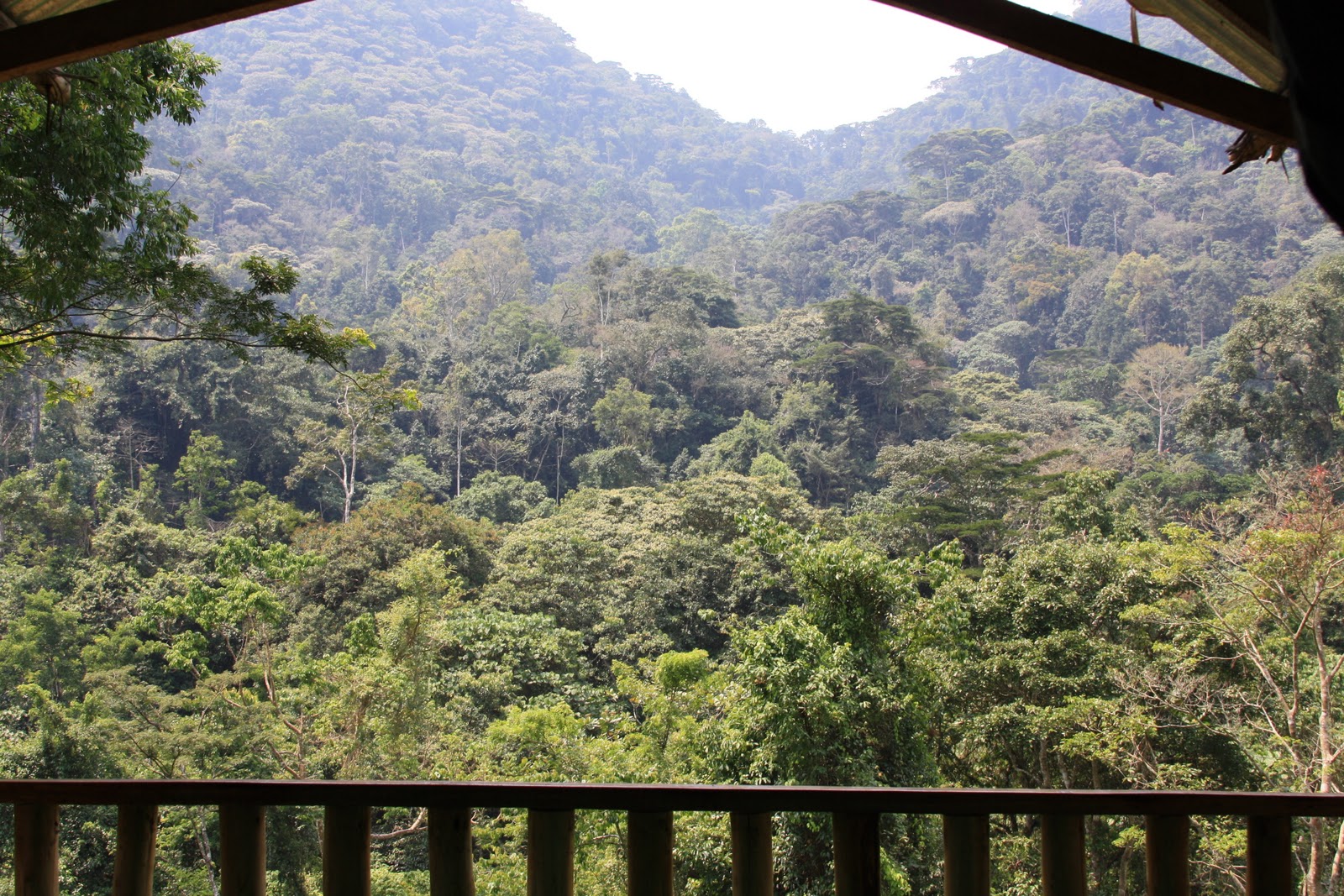
Bwindi - dense rainforest home to the mountain gorillas
After a couple of days on our lake side resort, we were more then refreshed and ready for our next adventure. Today was kind of a filler day, we were able to wake up slowly and take our time at the breakfast table before meeting up with our driver guide for our final destination.  It was another beautiful sunny morning, and a perfect temperature.  Our drive took about 5 hours allowing us plenty of time to get settled into our new rainforest side banda overlooking the rolling hills of Bwindi.  We knew this was a special place the second we set foot on the grounds, not only were the surrouding stunning but the food was delicious and the staff were very kind.  We took them up on their offer to give us a tour of the surrounding village.  It was incredible how just how much the climate had changed from the "lake district" to the jungle region.  It was now very hot and sticky, not exactly a surprise considering its a rainforest, but we were only a few hundred KMs away from the lake region.

Ugandan long horned cow
We encountered many points of interest along our tour of this busy little community.  We started the tour with a nice walk along a meandering stream which led to a waterfall.  The only problem was in order to get to the water falls we would've had to cross the stream.  Since we had a full day of trekking the next day we decided it would not be wise to attempt this, especially after a couple of guys who were on the tour with us decided to attempt this cross and ended up knee deep in rushing water. It made for an entertaining moment, but surely it wasn't worth soaking their hiking boots to dip their head in the water.  Continuing the tour, our guide took us through tea and coffee plantations.  Because of the climate here they are able to harvest these crops a couple times a year bringing much needed income to this remote area. 
Coffee and Tea plantations

As we continued on through the village we came to an oddly placed hut in the middle of the forest.  We were informed this was where the shaman lived.  Unfortunately for us he was out at the moment (apparently he's quite the interesting character) so his wife gave us a run down of the various herbs they use to "cure" various ailments.  They have everything from simple pain killers and laxatives to "cures" for malaria and infertility.  Regardless of what we may or may not believe it was still intriguing to learn the strength of nature's healing ability.  To think these natural remedies have been in use for thousands of years is truely inspiring.
Banana Gin Distillers


Rippening Bananas
 Ironically the next point of interest brought us to the local makers of Banana Gin.  This was also quite fascinating to see as well.  They had a very primitive system of distilling bananas into pure alcohol and I'm pretty sure there was a LOT of perfecting (ie. sampling) going on by these distillers. Next we came across a banana farmer who demonstrated to us methods of rippining bananas.  Apparently for bananas (and I suspect this to be the case for most fruit) they don't all rippen at the same time, they in fact rippen one at a time.  But in order to sell these bananas to the markets, there is a need to have large amounts of bananas which all become ripe at the same time....so they dig huge holes, through the bananas stem and all into the holes and cover them with layers and layers and layers of banana leaves. Not only is this how they rippen them but its also the way that they are able to ferment them for things such as banana wine, and for further process down the river by the Gin distillers.  It was pretty incredible to stand by these holes where you could literally feel the warmth from the slowly fermenting fruit! 

Not sure about this wine
It was here that we were given the opportunity to taste test this local delicacy (and if there was a way to write sarcasm, this would be the extreme sarcasm font).  Although we were all kind of hesitant to try their brews, we figured, well how bad could it be?  So the first beverage that was poured for us was the banana juice, now I distinctly heard him say banana JUICE however, our fellow tourist who was the lucky chap to try these concoctions first, took a small sip and say "mmm ok ok this must be the banana wine, I can definitely taste the alcohol".  And this pretty much summed up what was about to transpire...it was in fact just the juice but tasted absolutely horrible.  It tasted like something you had left in the baking hot sun for three weeks...ughh I was scared to even think about what the gin tasted like.  But onward with our taste test!! Next was the wine, the funniest thing was that we were all standing around in a circle watching the tour leader pour us a small glass of the stuff, we'd take a sip and kind of nod politely and pass it to the next person...and EVERYONE had the exact same reaction.  At this point I started thinking, maybe this is a form of entertainment for these locals, to trick us poor unsuspecting tourists into thinking these guys actually drink this stuff!  Next was the Gin, when he pulled out a bottle that was as translucent as water I began thinking the one girl in our group who claimed she didn't drink alcohol was the smartest of the lot.  Aside from the 95% alcohol I shot before doing the worlds most dangerous road in Bolivia, this was the most wretched, unbearable substance that's ever touched my lips!  But it made for good times as we all laughed and joked about what type of dire situation of boredom we'd all have to be in to even contemplate having a couple drinks of this stuff.  Oh well, clearly not for tourists!


The next stop was the Bwindi Watoto Primary School.  This portion of our tour was very inspiring, the school was built and funded entirely by volunteers.  The school was started by a couple of American volunteers who were travelling the area in the hopes of seeing the gorillas.  It was basically a 1 class school built from locally made bricks, and if I remember correctly had only a couple of teachers. The school was set up for orphans and children of very poor families in the region.  We weren't told this, but given its location I would assume a lot of men died in civil strife since we were quite close to both the Rwanda and Congo borders.  The hospital in the area was also set up on the same premise.  It was also built by volunteers through the donations of many people who lived abroad but had past through this area at some time in their lives.  Part of the tour was of course to show you what tourists dollars had accomplished and it was really nice to see the donation dollars making a real difference in the lives of these very poor people.  Before this hospital was built, the nearest one was over 400km on extremely rugged roads where most people's only method of transportation is a bicycle or maybe a motorcycle at best.  The main focus of the hospital isfor new borns and their mothers, and also for sick children, but they also do things like promote and give out free bug nets to the locals. This has had a dramatic affect in the incidents of malaria in this region. 
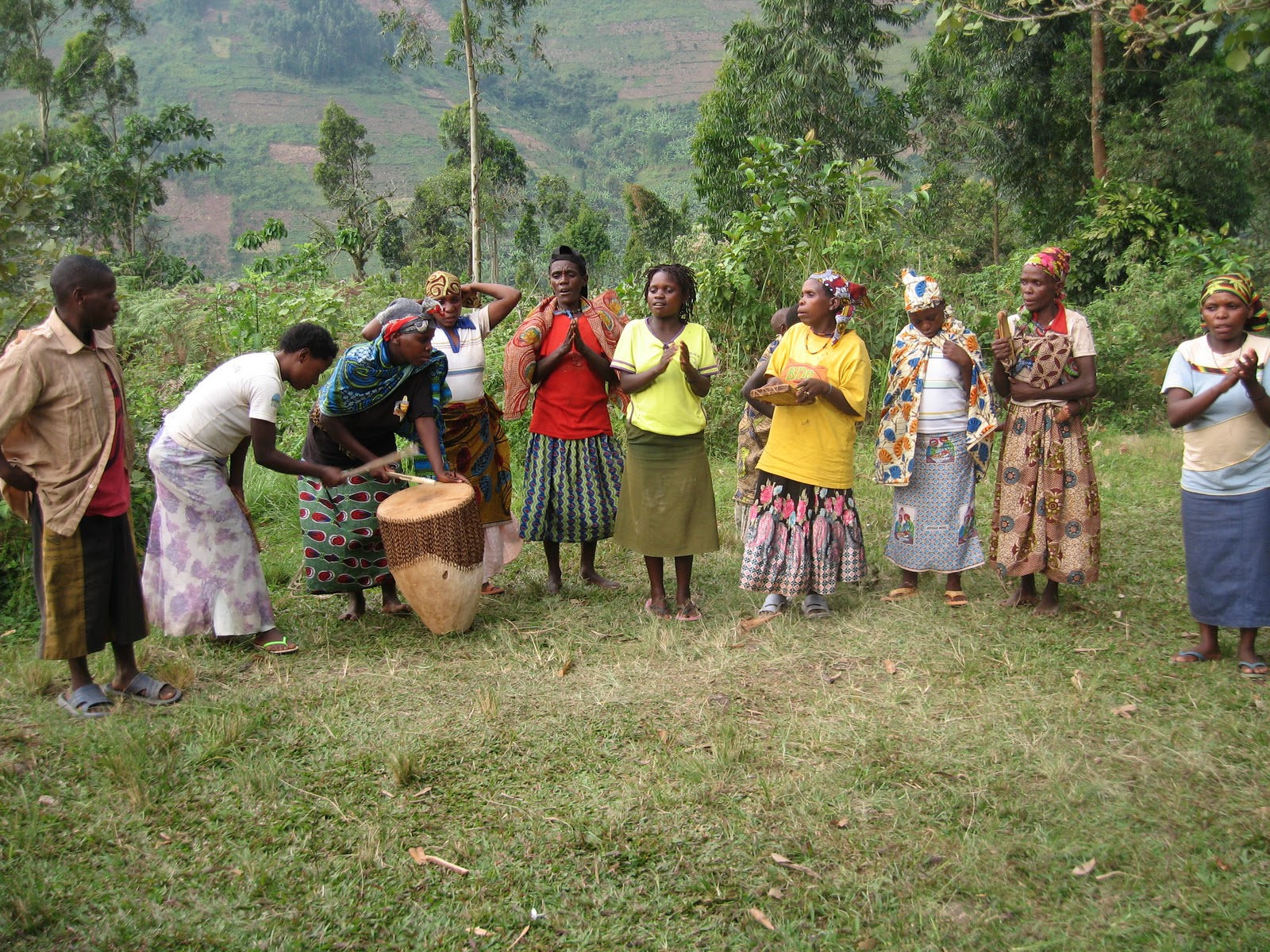
A Bwindi hoedown by the Batwa

The final portion of our tour took us to the top of a hill where the local Batwa people were to put on a show of music and dance.  On our way up the hill we got an understanding of how quickly rain can come.  One minute it was nice and sunny, the next it was extremely windy and we could see very dark clouds coming in from over the mountains.  Luckily it didn't rain to hard and the Batwa put on a good show for us. These people were probably the biggest losers when Uganda decided to make this region a national preserve in order to protect the gorillas. In being a preserve the government evicted all of these forest dwellers and forced them to intigrate into local communities.  The park was brought into existance relatively recently (1994) so all of the Batwa people there had been born and raised in the forest.  I could not even imagine having to deal with such an upheavle.

Batwa footstompin dance

We slowly made our own way back to our bandas where we bought a couple beer and watched the sunset behind the heavily forested hills...tomorrow we track gorillas!!!

Mar 30, 2011

R&R in the lake region

I don't know what it is, but in true Ryan fashion, I gave up writing in my journal after a major hike...this is now the 3rd time in a row that this has happened and I just realized this trend.  Thanks to my lovely wife (I knew I married you for a reason) I'll at least have another source other then my memory (annnnd maybe google)to go by...

After our extremely challenging hike into the Virungas we were more then ready for some relaxation at one of Southern Uganda's most popular lake, Lake Bunyoni. I had drank a ton of water and re-hydration salts in order to restore the fluids in my body after such an arduous trek. I also made sure to stretch before bed which might have been why I wasn't AS sore as Marlene.  The drive to Bunyoni was about 3 hours of winding terraced hillsides, once at the lake we could see why its been dubbed "the Switzerland of Africa".  As per Marlene its very beautiful but boring...and I suppose compared to all of our other experiences thus far, yes it is boring, but both needed and deserved.  We were staying at a western type resort (not wild west but western world) which had a combination of resort syle cabins and also options for tenting.  This was a very busy place especially since there were two buses full of Swedish tourists on an overland adventure.  When we arrived they seemed to have a monopoly on the best sunning areas (on the dock) but Marlene and I wormed our way in there when they weren't looking :)  We spent many hours on the dock and on the grass sunning and reading.  Marlene spent lots of time on the internet, I don't know if its because she missed the world back in Canada that much or if she was really that bored.  Either way it was very relaxing and a great place to recover. There were several tours that were available including a boat ride of the surrounding area, a canoe ride in a local canoe and also hiking tours, but we weren't really interested in the hiking at this point.  For today we were happy just laying around catching some sun.

View of our Resort on Bunyoni
One of the major drawbacks about this place is that a) the service is VERY slow and lacking and b) the food options are very limited.  Much like a few other places we've been to in Uganda so far, this resort had a HUGE menu with tons and tons of items...unfortunately they just seemed to be there for show and they didn't really have much aside from very simple things like pizza and pasta.  At one point all we wanted was a sandwich and were told they were "out of bread"!!! How can a resort hosting close to 100 people be out of bread completely?? No idea, I guess this is what Anne's friends meant by "Ugandan's are switched off for the most part".  At one point we had to find our driver Vincent and ask him to drive us into town to find somewhere to eat cause apparently somebody forgot to go shopping!  I don't know how this is possible and we were both very disappointed with this resort, the most troubling thing for these business owners is that we are not particularly demanding customers, but boy did they hear an earful from us! 

Marlene and the terraced hills of lake Bunyoni

The one tree of Punishment Island
The next day we engaged in a couple more activities (other then dock sitting!) and decided to go on a boat ride to see the lake.  This turned out to be something to help pass the time as there is really nothing too fantastic going on.  The view is spectacular and watching the locals come in via traditional canoe was interesting but the only landmark of any significance is one that most places would not want to known for.  Its a little place called "punishment island".  The idea was simple, the local people used to leave un-married pregnant women on the island to either die of hunger or to drown while trying to swim back to shore.  Although the island is not particularly far from the mainland in those days (and still to this day) it was rare for the locals to know how to swim.  The only other way they could survice was if an un-married felt he would not meet another woman, he would paddle out to the island in the middle of the night and snag himself a bride. Although this practice has been abandoned, apparently, it is still possible to find women who were picked up from punishment island today.  The island we were shown to be punishment island didn't seem like much more then a bunch of reeds clumped together, as in, it didn't seem like there was much solid land to stand on.


The boat ride didn't last too long, though it did last longer then our market visit that followed. The coolest thing about the market, by far, was watching all the locals bring in their goods by canoe.  Apparently a lot of these people spend all day paddling themselves to the market place in order to sell their goods.  This happens once a week.


The View of Lake Bunyoni from our Resort
Later that evening we decided to take a little paddle in a traditional canoe.  The plan was to paddle out of our little bay to watch the sun set.  Although we are both very adept at paddling regular canoes, unfortunately our experiences in the Canadian wild was little help paddling these hollowed out logs. These "canoes" were exactly that, a very large hollowed out tree, with no shape, making it nearly impossible to steer let alone balance!  There were quite a few near tips and I began to feel as though I couldn't even put my paddle in the water without risking an unwanted swim at dusk!  To make matters worse there were several people who had taken making entertainment out of watching people like us attempt to maoever their way out of the bay. We did finally get the hang of it (sort of) and managed to see a beautiful sunset in the process.

Although we enjoyed the rest and relaxation this lake provided we were also very excited to get moving the next morning...after all, we were going to see one of the most endangered species on the planet!
traditional canoe on lake Bunyoni


Feb 12, 2011

Hiking the Virungas

Virungas in the light of the rising sun
The birds are chirping and Marlene’s watch alarm was telling us to get up but our bodies and minds were telling us otherwise.  This seems inhumane to be up before the sun on a “vacation”.  It’s quite cool and foggy this morning as we make our way to the dinner for breakfast.  We thought we had left with plenty of time but it was clear the second we got off the main road that our driver didn’t really know where to go.  Fork in the road (driver mutters to himself) another fork in the road (more muttering) yet another fork in the road…hmmm maybe we should ask someone for directions our driver says.  Well maybe if there was somebody to ask in this foggy, desolate, base-camp of a town.  After much cursing, and lots of guess we did finally arrive at our destination and our driver seemed as surprised as us that we ended up in the right place.  We arrived just in time to get our briefing.  There were 3 couples 1 guide and 2 guards in all (the guards were in case we happened upon some elephants, or at least that’s what they said, who knows, we were heading in the direction of the congo).


The Bamboo Forests
The first two hours of the hike were fairly easy and quite fast paced as we made our way to the edge of the bamboo forests.  We stopped for a water break and were told this is where the challenge begins.  It was interesting to see the change in biodiversity, first through a massive bamboo forest, then through a mossy tree forest.  Once into the moss, things really started to get steep and I began to breath very heavily, my body had been here a few times before; it’s the feeling that your heart if trying to jump out of your throat, it quickly goes away once you stop walking.  However, the pace being set was not one which was conducive to much stopping.  By the time we neared the first summit I was sweating profusely, my legs were getting heavy and I began to feel light headed.  Again, I knew this feeling from hiking the Inca trail; it’s not a good sign as it’s the first step (pun intended) to altitude sickness.  I was very much relieved to arrive at the first peak and admire the incredible view, the trouble was I could also see the next two peaks we had to climb and they didn’t look too friendly.  Our guide chose now to tell us this is the point that most hikers turn back.  But troopers that we are, after a quick break and a snack we were set to climb the second peak…but first we had to climb down the first peak.  The climb down was only partially relieving because we knew we would only have to climb back up on the way back. 

Atop the First Peak
The second peak is where the ladder ascent began.  Marlene seemed to be doing quite well on these, maybe she had more practice on the jungle gyms in her earlier years, or maybe she had something to prove, all I know is the increase in elevation was starting to make me very noxious.  Once up top of the second peak I really started contemplating staying back while the others carried on.  Although this was my idea, and I love hiking in the mountains, for some reason the altitude was really hitting me hard and I contemplated for a second on being like most hikers before me who had attempted this trek.  But of course I’m too stubborn and determined to reach the 3rd peak that I continued on.  We could see that the third peak was just a cliff of a peak and we must’ve asked our guide 3 times if that was really where we were going.  The movie cliff-hangers ran through my mind as I got a closer look at the dilapidated state of the ladders we were about to entrust.


Staring at the third peak


between peak 2 and 3


Ladder up Peak 3

At one point on the climb there was a series of ladders which were straight up the crevice of a cliff, some 40M straight up.  We couldn’t believe we were doing this, we were literally a hundred feet up the side of a cliff with drops of several hundred meters on both sides.  Although looking around made me even dizzier, I just couldn’t help it, I seemed to be drawn to picturing myself in that moment, on the side of a cliff with nowhere to go but up. The odd thing is that I never once thought to myself “I’m going to fall” as most people do from these heights.  I wasn’t sure if I was experiencing vertigo or if this was the onset of altitude sickness, either way I was not feeling well at all.  For some reason I still felt safe enough to carry on.  Once at the top Marlene admitted she could not focus on anything but the next rung, I thought she was missing out on the best experience…but then again I was probably a little delusional at that point.  The views from atop the third peak were nothing short of spectacular.  On one side we could see the peaks we had just hiked, on the other we could see into the flats of Rwanda and on the other, the lush tropical jungles of the Congo.  These views reminded me very much of Peru with the jagged but very lush peaks.  The clouds were beginning to settle in and it was time to start heading back.  I was not looking forward to climbing back down those old rickety ladders with broken rungs and bent nails.  I was hopeful after lunch and lots of water I’d start to feel better, unfortunately it had to opposite effect and by the time I had climbed back up peak #2 I felt I was very close to barfing, so I stayed well back from everyone else.  Up to this point I hadn’t made it known that I was feeling this way as not to worry Marlene.  However what did worry Marlene was at one point on the final descent my legs just went completely numb and buckled, sending me face first into the turf.  This really was straight out of the cartoons as I scrambled to grab onto a clump of grass to prevent me from falling even further.  Thankfully that clump was very well rooted otherwise I would’ve been in for a very long fall.  After that little episode, I got the attention of the guide and guards who took my bag and followed close behind me.

Feeling pretty good atop the 3rd peak
styling on top a mountain
All in all the trip took us 10 hours to complete and we couldn’t have been more then happy to see our driver waiting for us.  It took all of our strength, endurance and will to do this trek and I would caution anyone that this is not your average mountain hike.  Although I probably felt the worst out of anyone due to the altitude wreaking havoc on my system, our fellow trekkers all agreed they had never done anything this hard in their lives…and these were avid travellers/hikers as well.  I could not have been more happy and relieved to know that the next two nights would be spent in lavish luxury, ok maybe not lavish luxury, but at a lake side resort!


Second peak and the other two Volcanoes

Feb 2, 2011

Enter the bread basket

This morning finally felt like a vacation as we slept in till the last minute before the hotel buffet closed.  We actually even went back to bed after the feasting on a wide assortment of delicious food.  We laid around and waited for our transfer from the hotel to the airport to arrive.  After a 2 hour flight we landed safely in Entebbe, Uganda and met our new driver Vincent.  He’s an older man who was a little hard to understand at first, but a really nice man.  He explains to us that he had been expecting us to arrive early in the morning, instead we arrived late that night, the poor guy waited around for hours at the airport wondering where we were, I guess nobody told him that we had booked our own flights from Nairobi to Entebbe.  A slight misunderstanding because it was not explained to me that the tour company actually booked our flights while we were on safari not knowing that I had booked our flights months ago! Oops! In the end it all worked out but we quickly discovered why they wanted us to arrive early in the morning, traffic is INSANE here!  It’s a chaotic combination of trucks and motorcycles.  We had heard that Ugandan’s love their night life, and the drive through the suburbs of the sprawling city demonstrated this perfectly.  It’s rows and rows of kiosks selling BBQ meat and beer and there are tons of people gathered out front of each. All I know is I’m really glad I’m not driving! Once we arrived at the hotel it didn’t take long to realize what all the articles and books we had read about Uganda were talking about in terms of service.  I’m not sure what it is, if it’s a language barrier issue or an accent issue, but they don’t seem to be able to understand us very well.  We wondered whether they only heard what they wanted to hear or if they really didn’t understand us.  For instance if we ordered a tea, they’d say with milk? No milk.  Ok so tea with milk.  No I said no milk. And of course it would come with milk.  Oh well, I guess we’re now on what they call “African time”.  Tomorrow we have another very long day ahead of us as we make our way to the most south western part of Uganda to do some volcano trekking!

Well today we are in for one hell of a drive, but hey, it’s not like we aren’t used to it and have never done it before.  And at least we will get to see what the country actually looks like on the ground, well, the south of it anyway.  On our way down we drove through many small villages and the one commonality was the amount of bananas.  Neither of us had ever seen anything like it, the way they are able transport these bananas is quite amazing.  On our way out of the city it was transport after transport over flowing with bananas delivering them to the urban population who are getting ready for their work day. Vincent kept telling us that the entire country runs on bananas, that 3 varieties of bananas provide sustenance for the majority of the population.  The bananas arrive not by the bunches we see back home in the grocery store, but with the entire stem intact with dozens of these bunches per stem.  Watching them unload the cargo was interesting, but even more fascinating was the way the locals transport them via 10 speed bicycle in the smaller towns.  They are able to very creatively attach several of these stems to 1 bicycle with literally hundreds of bananas at a time.  It was quite the sight to see long lines of locals pushing these bikes up and down the shoulders of the highway.
Vast Farm Lands

As we continued further and further south, the terrain increasingly got more mountainous.  The scenery was absolutely stunning as we passed terraced mountain tops which make good use of all available terrain.  I suppose the trade off is that the entire region to the south has been cleared of trees and brush to make way for agriculture.  Here they grow beans, cabbage, corn, and potatoes…not what you’d expect of a tropical location, but I suppose these are the things that are easy to grow and provide nutrition for the locals.  The tropical, mountainous topography kept reminding Marlene of her travels to Colombia.  It was a very long drive, but at least our surroundings made it all the more inviting.  The most stunning of all scenes was after when we caught a glimpse of lake Bunyoni from high up in the terraced mountains.  We would be returning to the lake in a few days for some rest and relaxation.

After about 10 hours of driving we finally approached our destination.  At this point, the twisty turny nature of our drive had done a number on Marlene who was trying to find a position to sit in which did not make her feel queasy.  As the road turned from freshly paved asphalt to dirt, we rounded our last mountain pass, and there, way off in the distance, with absolute and distinct clarity, were the series of 3 massive volcanoes that up the Muhavura Mountain range, staring us straight in the face.  We pulled over to the side of the road to stare in aw and our driver turned to us with a huge smile and said “so…which volcano would you like to climb?” gulp!! I knew these volcanoes were huge, but to actually see them in the dying light of day was quite intimidating. Upon arrival into Kisoro, we made our way into the tourist centre to decide which volcano we were going to climb.  After intently reading all of the descriptions of the treks up these mammoth beasts we both kind of looked at each other with indecisive gazes.  They all sounded very intriguing but VERY difficult, a lot more difficult then anything we had read in books or on line and we kind of got the feeling that we had been mislead.  We opted for Mt. Sobynyo (Sovenio) which was the second largest of the 3...but still 3659M above sea level!  We based our decision on the fact that at the peak, we would be at a point where 3 countries meet:  Uganda, Rwanda, and the Congo.  When we booked this trip we both had the urge to dip into the Congo for Gorilla trekking but decided it was not a good idea due to the constant instability in the region.  So….this would be as close as we would get to entering the DRC.  Oh yes, and in case it needs to be mentioned, all of these volcanoes have been dormant since the Holocene age J

The Virunga Mountain Range
We eventually checked into our guest house accommodations and were greeted by a lovely, smiling hostess who gave us both hugs and took our orders for dinner. She was incredibly friendly but we are quickly discovering there is a distinct difference in service level here.  The funny thing is that each place we’ve been to has HUGE menus but ¾ of the stuff on them are not available!  So often we would get our hopes up for something we hadn’t had in a long time, only to be told they don’t have that right now.  In addition, everything takes for ever to be made and served.

We went to bed early because 5:30am comes very fast and early.  Tomorrow we meet the mountains!